Anaadeh Antah
The end of the beginningless
The beginning and the life of Brahma
saha yajnaah prajaah srshtvaa puraa-uvaaca prajaapatih |
anena prasavishyadhvam eshah vah-astu ishta-kamadhuk || - Bhagavad Gita 3.10
The universe created by Brahma is called Brahmaanda. At the beginning of the current Brahmanda, Hiranyagarbha (also known as Brahma, the creator) created the world along with yajnas (which refer to the Vedas), so that people can perform those yajnas and fulfil their desires. This is the dharmic way of leading one’s life.
Based on the above pramaana (authoritative source), we can say that Sanatana Dharma is at least as old as Hiranyagarbha himself.
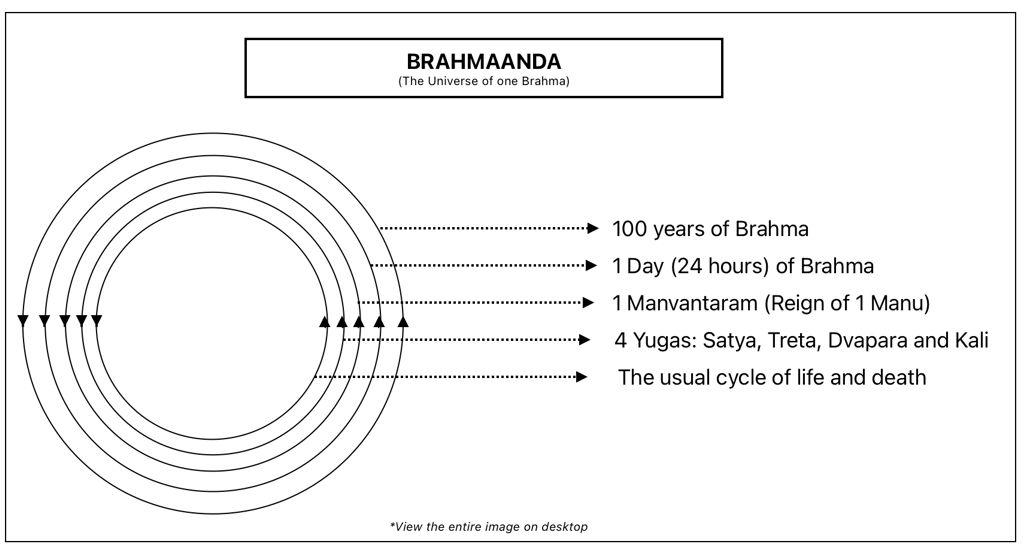
One daytime (12 hours) of Brahma equals 4.32 billion human years. His night is of equal duration. Thus, one full day of Brahma equals 8.64 billion human years. Brahma’s lifespan is 100 such years, which is equivalent to c. 8.64 x 360 x 100 billion human years.
At the end of his 100-year lifespan occurs the Mahapralaya — the Great Dissolution. We are currently in the 51st year of Brahma, which gives a perspective on the vast age of this Brahmanda.
One day of Brahma
Inside this great creation and dissolution taking place over 100 years of Brahma, there are several other cycles .
avyaktaad vyaktayah sarvaah prabhavanti ahar aagame |
raatri aagame praleeyante tatraiva avyakta sanjnake || - Bhagavad Gita 8.18
According to Gita 8.18, all beings manifest during Brahma’s daytime and dissolve into the unmanifest during his night. This daily creation and dissolution continues cyclically.
Manvantara
Each day of Brahma is further divided into 14 Manvantaras. Each Manvantara refers to a period ruled by one Manu, the progenitor of the human race. First Manu is the mind-born child of Brahma, and from him all other beings came into existence.
We are currently under the rule of seventh Manu named ‘Vaivaswata’. Based on the Vedas, Manu codifies the dharma for his period in the text referred to as ‘Manusmriti’. Dharma is not rigid either, it adapts without contradicting foundational Vedic principles. Manusmriti 12.106 notes that an authoritative person may logically reason the dharmas for a particular period without contradicting the original sources. As a result of this, we have several dharma sastras (scriptures on the dharma) written by Rishis who understood not only the vedas but also have direct spiritual experiences of Tattvas. Some such texts are Yajnavalkya smriti, Baudhayana smriti, Mahabharata, Ramayana, and Upanishads.
Four Yugas
Each Manvantara has several Cycles of Four Yugas: Satya yuga, Treta yuga, Dvaapara yuga and Kali yuga. People are more virtuous and noble in the Satya yuga. But with each passing yuga, the adharma increases and the virtuous tendecies weaken. Currently we are in the kali yuga where tamasic (evil) tendencies of people are stronger. This can be witnessed in the intensity of our mental afflictions including Kama (strong desires), krodha (anger), lobha (greed) etc...
Samsara (The cycle of life and death)
We ignorantly think that the world begins with our birth and ends with our death. Note that we keep coming back again and again into this world.
brahma-aadishu trna-anteshu bhuteshu parivartate |
jale bhuvi tathaa-aakaashe jaayamaanah punah punah || - Mahabharata
According to the Mahabharata, our births range from Brahma, the creator, all the way down to a blade of grass. Sometimes we are born in water, later on earth, and sometimes in the air, with no end to this cycle of births and deaths. Any jiva does not have control over this phenomenon, but he has an option to exit this endless loop, and that is what is called Moksha (liberation).
te hlaada paritaapa phalaah punya apunya hetutvaat || - Patanjali Yoga Sutras 2.14
Every human birth has a mix of pleasures and pains; only the proportion varies depending on one’s past karma. Patanjali notes in Sutra 2.14 that enjoyments are due to our past good karmas and suffering stems from our past misdeeds. When we experience joy, we get attached (raga) to that joy and want to retain it forever. Likewise, when there is suffering in life, we engage in karmas in order to alleviate it.
Either way, we end up committing karmas (good or bad), and we will have to be born again to experience their consequences. Thus we get stuck in this cycle of life and death with no end in sight.
parinama taapa samskaara dukhaih gunavritti avirodhaat cha dukhameva sarvam vivekinah || - Patanjali Yoga Sutras 2.15
Yogis perceive pleasures differently. Any pleasure leads to attachment, and that transforms into pain when the pleasure ends. For instance, one who is used to consuming sweets every day will feel unsettled on days when he cannot access his desired dish. Also, every pleasure leaves a samskara (mental impression) in the mind. Because of these samskaras, when you come across a desirable object, a craving arises to indulge again. The more you feed pleasures, the stronger the samskaras become, and thus you are stuck in a vicious endless loop. Since some karma is involved in acquiring pleasure, it leads to more rebirths. That is why, for a yogi, every experience is ultimately pain.
shoka-sthaana-sahasraani harsha-sthaana-shataani cha |
divase divase mudam aavishanti na panditam || - Mahabharata
An ignorant person is overwhelmed with thousands of sorrows and hundreds of joys every day, but not a spiritually wise person, because he understands that they are only transformations of chitta. These transformations will continue as long as his chitta exists. He is committed to spiritual practices in order to put an end to the chain of rebirths.
And then comes the next Brahma
The above cosmic phenomenon does not end after 100 years of Brahma. Essentially, Brahma is a designation of the creator with a fixed term. The above cycle refers to just one Brahmanda. At the end of one Brahma’s tenure, another yogi becomes Brahma and creation begins again. This cosmic phenomenon has been going on eternally. There is no beginning (Anaadhi) to this phenomenon and there is no end (Antah) either.
The uniqueness of the Yoga Darshana is that a yogi can assess his progress on the spiritual path. At each level, a yogi acquires siddhis (vibhutis) which bestow special yogic perceptions or extra-sensory faculties.
samskaara-saakshaat-karanaat purva-jaati jnaanam || - Patanjali Yoga Sutras 3.18
After mastering the practice of samadhi (the eighth limb of Ashtanga Yoga), the yogi acquires the ability to see his past lives and the karmas responsible for his current birth.
tatah Animaadi praadhurbhaavah kaaya-sampat tat dharmaat-anabhighaatah cha || - Patanjali Yoga Sutras 3.45
When he attains Vitarka-anugata Samprajnata Samadhi, he is endowed with the animaadi ashta siddhis. These include making one’s body light like a feather or very heavy, taking a minute form or a huge form, etc. We notice that some characters in Indian mythology have such abilities, especially Hanuman from the Ramayana. These stories might appear fictional to a layman, but one has to understand that these beings are yogis who acquired such siddhis through yogic practices.
sattva-purusha-anyata-khyaati maatrasya sarva-bhava-adhishtatritvam sarva-jnatritvam cha || - Patanjali Yoga Sutras 3.49
As the yogi progresses, he experiences the reflection of purusha in his chitta and realizes that his chitta is inert, and that it is purusha which gives it the ability to connect with objects and experiences. For instance, when we see an electric bulb we perceive that light is coming from the bulb, but it is the electricity which is making the inert bulb glow. Similary, Purusha animates the inert chitta and then the chitta goes on to experiences pains and pleasures. This direct realization is called sattva-purusha-anyata-khyaati. This experience bestows two siddhis: sarva-bhava-adhishtatritvam and sarva-jnatritvam. The yogi becomes omniscient and gains mastery over all tattvas. As a result, he acquires the ability to create. He could become Brahma if he has the desire to create.
We now understand that Brahma is an advanced yogi who has acquired the ability to create. Note that Brahma is not a liberated yogi. In order to progress spiritually, he has to take birth as a human after his 100-year term. There are innumerable such Brahmas and innumerable Brahmaandas.
The story of Jaigishaviya
Vyasa Bhashya, an authoritative commentary on the Yoga Darsana, mentions the experience of Jaigishaviya, a yogi who was at the verge of liberation. He passed beyond the stage of being a creator (Brahma), and he even had a glimpse of kaivalya (liberation). Another yogi named Avatya comes and asks him about his experiences from past births. Jaigishaviya says that because of extreme level of sattva in his chitta, he could recollect his past births upto 10 Mahasarghas (10 Brahmaandas under 10 different Brahmas):
Births in lower beings such as birds, plants, worms, and other animals. Usually those who perform evil karmas take birth in such species, and go through suffering.
Human birth: When there is a mix of good and bad karmas, you take a human birth. That is why there is no human being who has only pleasures, or only pains.
Birth in Devayoni-s: People who have done a lot of good karmas end up going to heaven in order to enjoy the benefits of their good karmas. But once the merit of their good karmas end, they have to come back to lower planes.
That is why he considers all those lives only as suffering.
When Avatya asks him about the spiritual siddhis he has acquired as a result of the accomplished samprajnata samadhis. As noted above, Jaigishaviya has even acquired the siddhi to be a creator. He responds by saying that even these siddhis are only a pain compared to Moksha wherein the chitta merges back into mulaprakriti, thus ending the suffering for once and all.
Liberated Yogi: Jivan-mukta and Videha-mukta
According to Jivan Mukti Vivekah, a jivan-mukta (liberated yogi while alive) is described as:
sa chakshuh achakshuh iva, sa karnah akarna iva, sa manaa amanaa iva, sa praanah apraanah iva || - Jivan Mukti Vivekah
He is like one without eyes, although he has eyes
He is like one without ears, although he has ears
He is like one without mind, although he has mind
He is like one without praana, although he has prana
In the normal humans, Indriyas (sense organs) are connected to vishayas (sense objects); but in the case of a liberated yogi, there is a constant flow of nirodha samskaras which doesn’t let his mind connect to vishayas, as per the below sutra.
tasya prashaanta-vaahita samskaaraat || - Patanjali Yoga Sutras 3.10
Once he exhausts his prarabhda karma which led to his current birth, he becomes a videha-muktha. He will not be born again.
videhamuktah na-udeti na-astameti na shaamyati |
na sat-na-asat na durastah na cha-aham na cha na-itarah || - Laghu Yoga Vaashishta 5.99
A videha-mukta
Neither experiences joy, nor experiences sorrow
Neither he is devoid of joy and sorry (because ‘he’ doesn’t exist anymore)
He is not sat (kevala purusha / para brahama), nor he is asat (mula prakriti / avidya)
Neither he is ‘far away’, nor is he ‘here’
Neither he is ‘I’, nor he is ‘not I’
This is the end (antah) of the beginningless (anaadhih).
OM